…
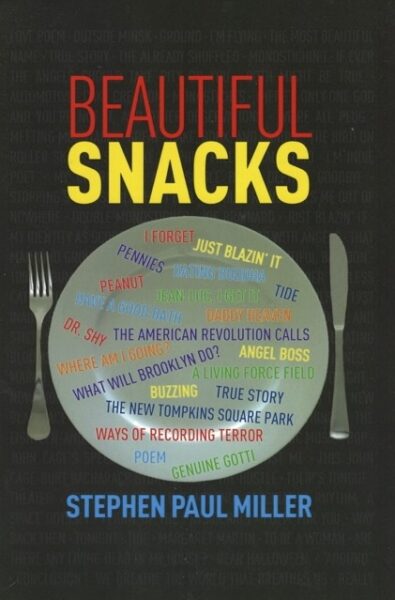
After reading Beautiful Snacks, I have to hold myself back because I don’t want to seem hyperbolic when I say that I really like Beautiful Snacks whose first poem is about a father and son that is touching and funny and sets the tone and mood, I think, for the whole book.
When I read certain poets, it’s like they’re in the room with me. We’re having a conversation. It’s a kind of metamorphosis, the enjoyer and the joy. Good poets put me in the present, their present, and I get to share it with them.
In one poem called “I’M INDIE POET” Stephen Paul Miller writes:
I don’t do any one thing.
Indie Poetry hangs in the strike zone for everyone to hit.
His poems sound like he talks, but out of this common speech, this common ground where every reader can come and hit a home run, out of himself he writes uncommon poems.
And like the poem says, he doesn’t do any one thing. Like another New Yorker we know, Stephen Paul Miller contains multitudes. He’s a standup comic throwing zinger one liners at us, a professor at St. John’s University too lecturing about history and politics, which he has studied in depth, and knows to be true, a PhD who’s not afraid to walk up to Fame and start a conversation any old place whether it be in a restaurant, during intermission, or on the street. Jean Luc Godard, Bill Clinton, John Ashbery, and John Cage are among the celebrities in Beautiful Snack, and the gossip is not apocryphal, but doubtlessly deliciously real.
IT ONLY NOW OCCURS TO ME HOW MUCH
JOHN CAGE INSPIRED BURT BACHARACH
This John Cage-Burt Bacharach story is true.
There’s a wonderful French
horn nearby
and the poetry attached to it
is intense
and sweats like crazy
in a space-time
where A.R. Ammons
and Mark Rothko
die on February 25th
and George Harrison,
Zeppo Marx, and
Meher Baba are born nearby on Feb. 25th—
the same surface when
Burt Bacharach
and John Cage are
early ’50s
New York
friends (true story)
when Burt writes a
piece for oboe &
2 other instruments
and thinking of Cage
feels it too
melodious,
and his great French composition
teacher says, Burt
never
fear being
too melodious—
and it changes his life
and we too should throw
out Burt’s beautiful net
and not fear making
too much sense
Does no dog lick the wind? —
Hillel tells you
“Where there is no
Man
Be One”
and
“The truth is what helps people,
The truth is what makes people
Big,”
says Meher Baba.
We’re all like Burt Bacharach
imperceptibly pushed by John Cage
in odd and surprising ways
striking one intricate and sublime
simplicity after another.
With Beautiful Snacks you get the dish, learn something too, and these poems care and look out for the reader like a teacher or a father would, or an affectionate son, and most of all I have to say that reading Beautiful Snacks was a lot of fun. Fun is Love. Love is Fun.
At KGB on May 11, Stephen Paul Miller read poems from Beautiful Snacks in the Vimeo that follows. Enjoy.
Stephen Paul Miller reads from Beautiful Snacks
No Description
“Where did the baby go?”
two-year-old Noah asks
as he flips through the Moses
kids’ book our friendly
born-again doorman gave him.
“Moses grew up,” I tell him.
But he keeps turning,
finds the Burning Bush,
yells “HOT!” and blows it out.
Then, coming to Moses’s tablets,
he finally gets the connection.
Pointing to the tablets,
he says, “Cake! Cake!”
The next day I go inside
a real-life ginger “cake” house
in a Chelsea art gallery
and think of Moses and Noah.
JOE BRAINARD
Fish
On music paper
Brings me joy.
Beautiful Snacks is published by March Hawk Press. You can check it out here:
Beautiful Snacks | Marsh Hawk Press
Beautiful Snacks by Stephen Paul Miller is a fearless, genre-bending feast for adventurous poets and readers mixing satire, spirituality, theater, and more.
Stephen Paul Miller reads his translation of Agnieszka Ginko’s poem Pierścionki: “Rings”
In Stephen Paul Miller’s new book of poems, Beautiful Snacks, he translates a poem from the Polish by Agnieszka Ginko, a poem called Pierścionki or in Stephen’s words, “Rings.” And here it is for you.
Stephen Paul Miller reads three inaugural poems
THE OPPOSITE OF CAPITOL VIOLENCE At the ’63 march on Washington A. Philip Randolph says “racists seek to strangle Congress.” I find myself so between. On January 5, 2021, We march to the sea in a good way, Taking Georgia to roll back the 2006 voting rights rollback Getting back to Reconstruction before we gave up on The non-violence at the electoral heart: What investigation needs to be taken?